
Safe Upholstery Cleaning at Home (Before You Accidentally Ruin Your Couch)
Here's something nobody warns you about. Your sofa looks fine right now. Sit on it every evening, maybe spill something once a month, wipe it up, move on. Seems clean enough.
But flip a cushion over. Look at the fabric under a bright light, not your living room lamp, actual daylight. Odds are you'll see a faint yellow or grey tint that wasn't part of the original color. That's months of body oil, dust, sweat, pet dander, and whatever else has been quietly settling into the fibers while you binge-watched Netflix.
Upholstered furniture absorbs everything. It just does it slowly enough that you don't notice until the couch is three shades darker than the day you bought it.
Check the Tag Before You Touch Anything
This step saves furniture. I mean it. Grab a flashlight, look under the cushions or on the bottom of the frame, and find the care tag. It has a letter code that tells you exactly what your fabric can handle:
- W means water-based cleaners are safe. This is the easiest to work with.
- S means solvent only. Water will leave marks or damage the fabric. You need a dry-cleaning solvent.
- WS means either works. Lucky you.
- X means vacuum only. No liquids at all. Professional deep cleaning service is really the only option if this fabric gets stained.
I cannot stress this enough. If you skip this step and just spray whatever's under your kitchen sink onto an S-coded couch, you might end up with a water ring that's worse than the original stain. I've seen it happen. A friend in Mississauga tried to remove a coffee stain from her couch with dish soap and warm water. The stain came out. The massive water mark that replaced it did not.
Step-by-Step Cleaning Without Wrecking the Fabric
Once you know your material, the actual process is straightforward.
Start by vacuuming the entire piece. Use the upholstery attachment, not the regular floor head. Get into the crevices between cushions and along the seams. This removes loose dirt so you're not grinding it deeper when you start wiping.
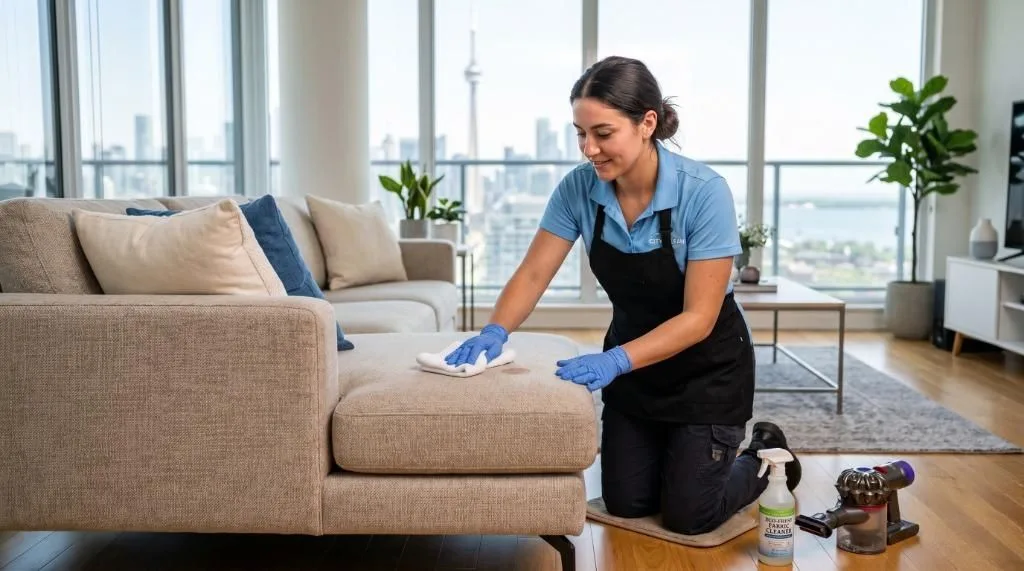
For W or WS fabrics, mix a small amount of clear dish soap with warm water. Just a few drops. Dip a white microfiber cloth in the solution, wring it out until it's barely damp, and blot the stained area. White cloth specifically, because colored ones can transfer dye onto light upholstery.
Blot. Don't rub. Rubbing pushes the stain deeper and can damage the weave. Work from the outside of the stain inward so you don't spread it.
For couch stain removal on tougher spots like wine or sauce, sprinkle baking soda on the area first, let it sit for 15 minutes to absorb moisture, vacuum it off, then proceed with the damp cloth method. Baking soda also handles odors surprisingly well.
After cleaning, press a dry towel against the area to pull out excess moisture. Then let it air dry completely. Don't sit on it wet. Don't use a hair dryer on high heat. Just patience.
Mistakes That Cost People Their Furniture
The biggest one? Too much water. Soaking upholstery fabric warps the padding underneath, creates mildew, and can permanently distort the cushion shape. Less is more. Always.
Second mistake: using colored cloths or patterned sponges. Dye transfer is real and heartbreaking on a beige sofa.
Third: scrubbing aggressively on a visible stain and ignoring the rest. You end up with one suspiciously clean patch surrounded by slightly dingy fabric. Now the clean spot stands out more than the stain did. If you're cleaning one cushion, at least lightly go over the adjoining ones so the color stays even.
And please don't mix cleaning products hoping for better results. Vinegar and baking soda together? Great for a volcano at a science fair. Not so great for deep cleaning for sofa and furniture fabric. They neutralize each other and you end up with salty water that does basically nothing.
When DIY Isn't Enough
Some situations genuinely need professional help. Old stains that have set for weeks or months. S-coded or X-coded fabrics where one wrong move leaves permanent damage. Pet urine that's soaked through to the padding. Or furniture you simply can't afford to risk because replacing it costs more than cleaning it.
Pure Maids offers professional deep cleaning service across Toronto and the GTA for exactly these situations. The team uses equipment and solutions matched to your specific fabric type, which is honestly the part most people get wrong at home. They handle the guesswork so your couch doesn't become an experiment.
If you've been staring at a stain for three weeks trying to decide whether to attempt it yourself, that hesitation is probably telling you something. Reach out to Pure Maids before the stain sets any further.